UNSW leads quantum technology revolution for national benefit
From foundational research to real-world applications, UNSW is spearheading quantum advances that promise lasting national impact.
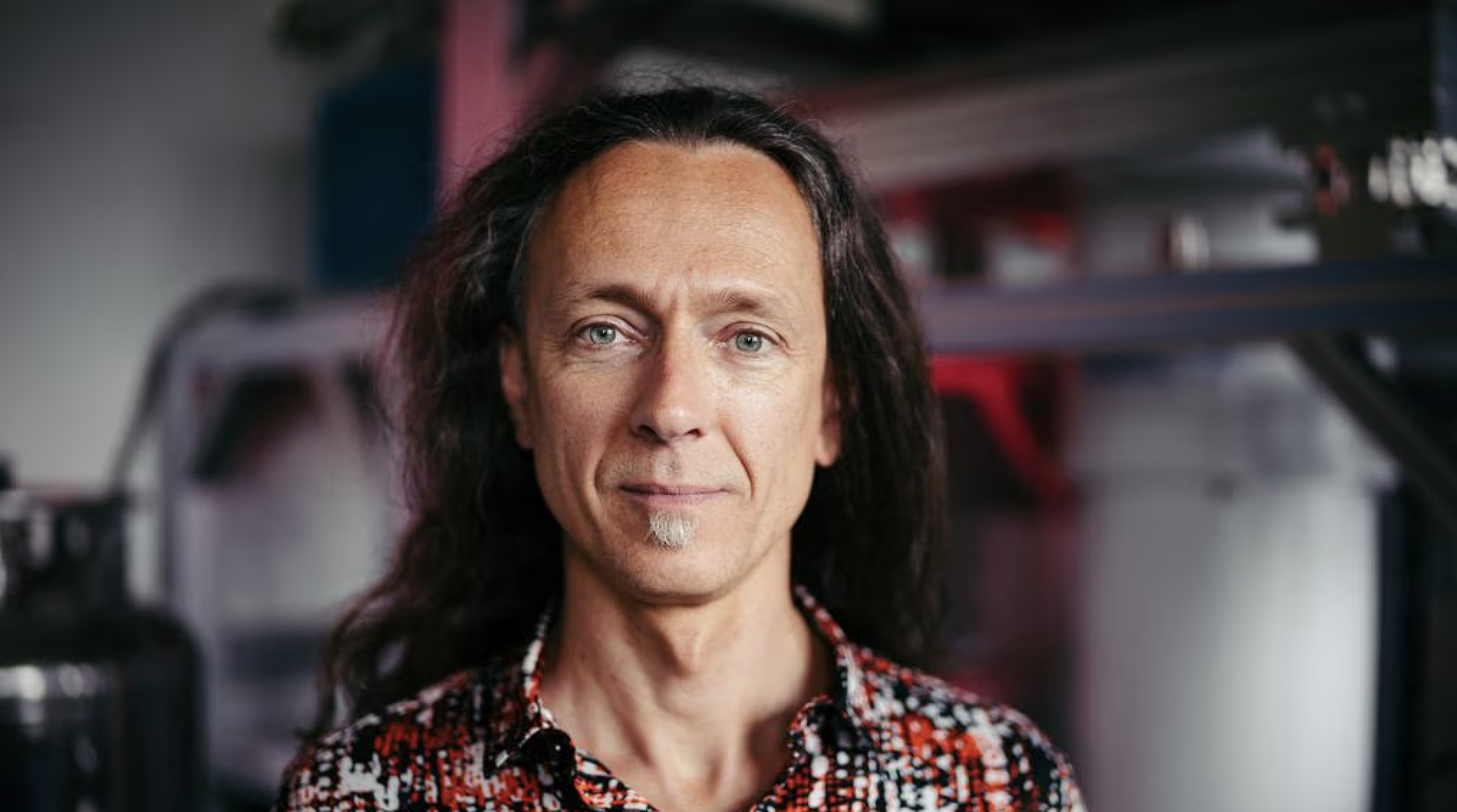
Andrea Morello, Quantum Engineering Professor at UNSW Sydney.
Mathematics and physics are the language and the tools of the physical world, and the pulsating heart of the deep tech revolution that is taking place in the field of quantum technologies.
Quantum computers promise to enable high-precision simulations and calculations for key problems in the fields of global energy and materials, pharmaceuticals and medical products, the financial industry, and travel, transport, and logistics. The 2025 McKinsey Quantum Technology Monitor forecasts a global economic value of quantum computing of between $US900 billion ($1.38 trillion) and $US2 trillionby 2035.
This is a sector where Australia enjoys a phenomenal first-mover advantage, a highly skilled quantum workforce, and an enviable concentration of quantum start-ups. Our challenge now is to bring these advantages to full fruition, by creating a globally competitive quantum industry, rooted within an ecosystem that keeps generating breakthrough science, training specialists workers and that delivers benefits for the broader society.
Between 1998 and 2001, two groundbreaking ideas were put forward in Australia to create practical, realistic quantum computers using silicon or photons. The Australian Research Council Centre of Excellence for Quantum Computation Technology, headquartered at UNSW, was established in 2003 to synergistically develop these exciting directions. This initiative delivered most of the early scientific breakthroughs that proved the viability of building quantum computers using silicon chips, or using beams of light to encode information.
At UNSW, we recognised early the strategic advantage of building quantum technologies on silicon – a platform already central to the trillion-dollar semiconductor industry that powers the modern information era.
Our researchers went on to achieve a string of world firsts: quantum bits in silicon, universal quantum operations, high-fidelity quantum logic and atomic-scale device fabrication. These breakthroughs demonstrated that silicon-based quantum devices are a competitive platform for the construction of large-scale quantum computers.
Just as important, these efforts helped grow a new generation of (Australian) scientists and engineers who are now global leaders. Their success shows the long-term value of investing in young talent capable of building technologies that have never existed before.
Building on this, some of us took the matter even further by establishing, four years ago, the world’s first bachelor’s degree in quantum engineering. This revolutionary educational offering adopts the highest standards of maths and physics (especially quantum, of course) education and blends them with the rigorous training in engineering design that consistently made the School of Electrical Engineering & Telecommunications at UNSW first in the country and among the top 50 in the world.
Today, UNSW is a cauldron of academic excellence and innovation in quantum science and engineering. We host two quantum start-up companies on our campus, Diraq Pty Ltd and Silicon Quantum Computing Pty Ltd, and a lively cohort of academics who operate at the international forefront of the quantum computing discipline. This concentration of basic research and industry translation gives UNSW a unique edge in the fast-moving world of quantum.
Our university seeks to remain a world leader in the research and workforce training that will enable the construction of utility-scale quantum computers – that is, computers capable of solving problems whose economic value exceeds the cost of developing and operating the device itself. To get there, we need to:
(i) drastically improve the performance of the underlying physical hardware, reducing the occurrence of errors that invalidate the outcome of the quantum computation
(ii) invent new forms of quantum software that can run using a much-reduced amount of hardware resources, and
(iii) develop methods to interconnect quantum computers, both at short and long distances, to benefit from the multiplicative power of quantum computation.
These are not standard engineering tasks: they require the invention and application of new physics, and the capacity to translate this new physics into functional, economical devices. They also require a joint effort across academia, industry and government, ensuring that none of the aspects of this complex challenge are left unaddressed, and that we continue producing a skilled workforce capable of pushing the next frontier.
The construction of a utility-scale quantum computer is one of the most exciting challenges ever faced by humankind. We are on the brink of creating a machine that has no equivalent in the universe. It has the potential to unlock unprecedented computational abilities that can give us new materials, medicines, catalysts and energy storage, and it affects vast sectors across finance, mobility and data security and many more we cannot even fathom today.
UNSW is intent on maintaining and expanding its global leadership in this field, and on playing its part in ensuring that all Australians will benefit from the quantum technology revolution that we are helping create.
Andrea Morello is a Quantum Engineering Professor at UNSW Sydney.