Startup Spotlight: Space CoLAB
Physics, not maths: Space CoLAB’s bet against quantum hackers
A room-temperature, diamond-based quantum communications system designed so that if someone intercepts the signal, they get nothing at all.
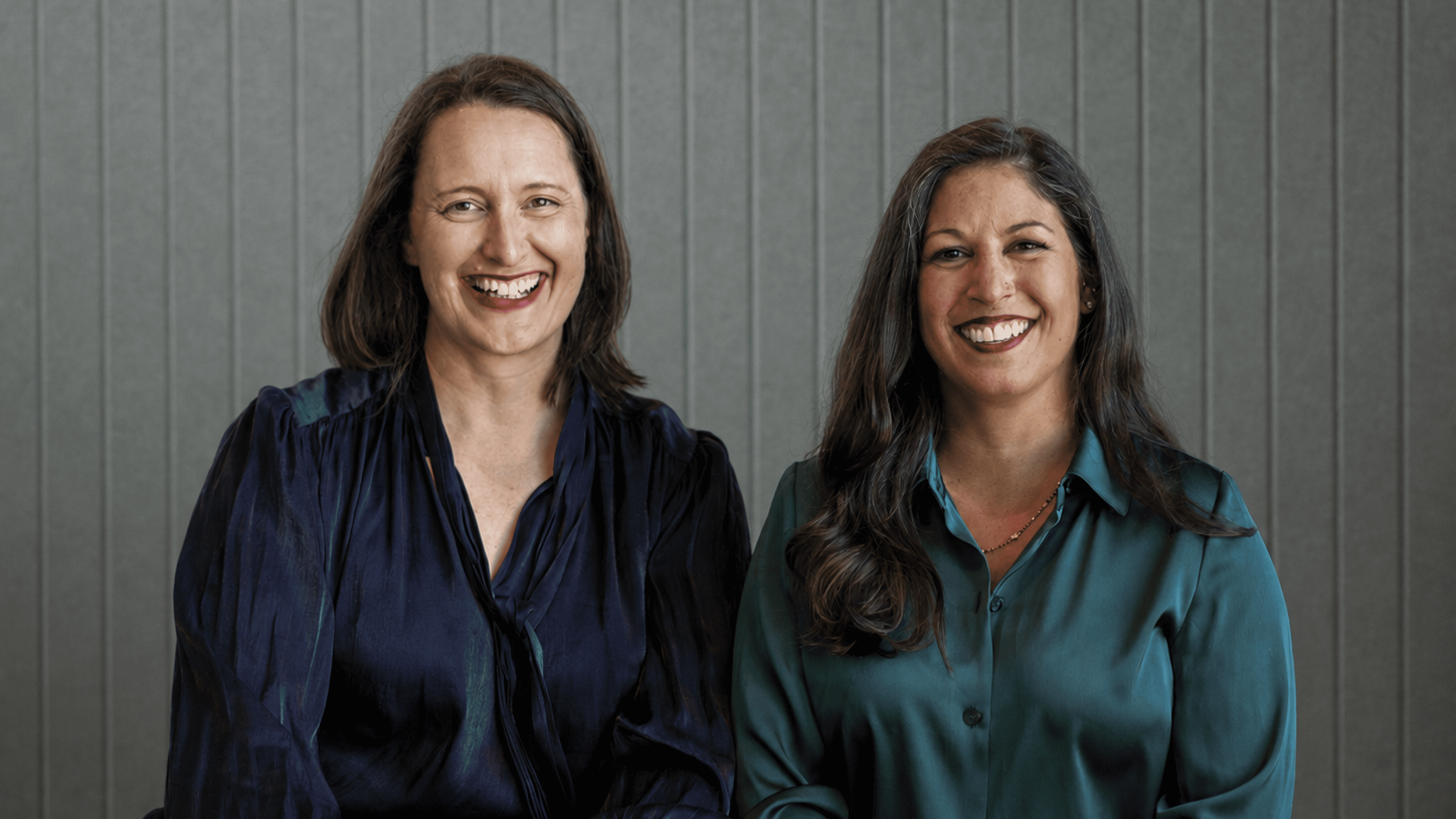
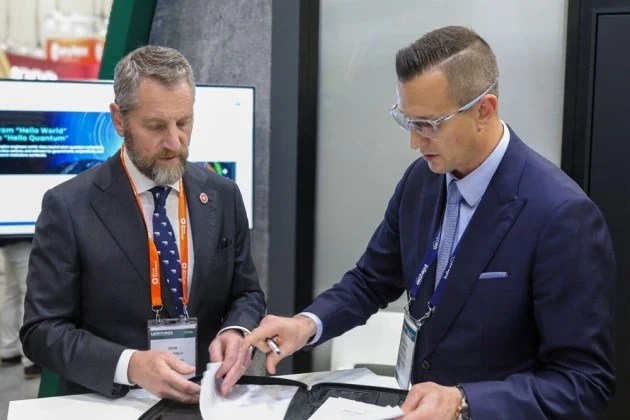
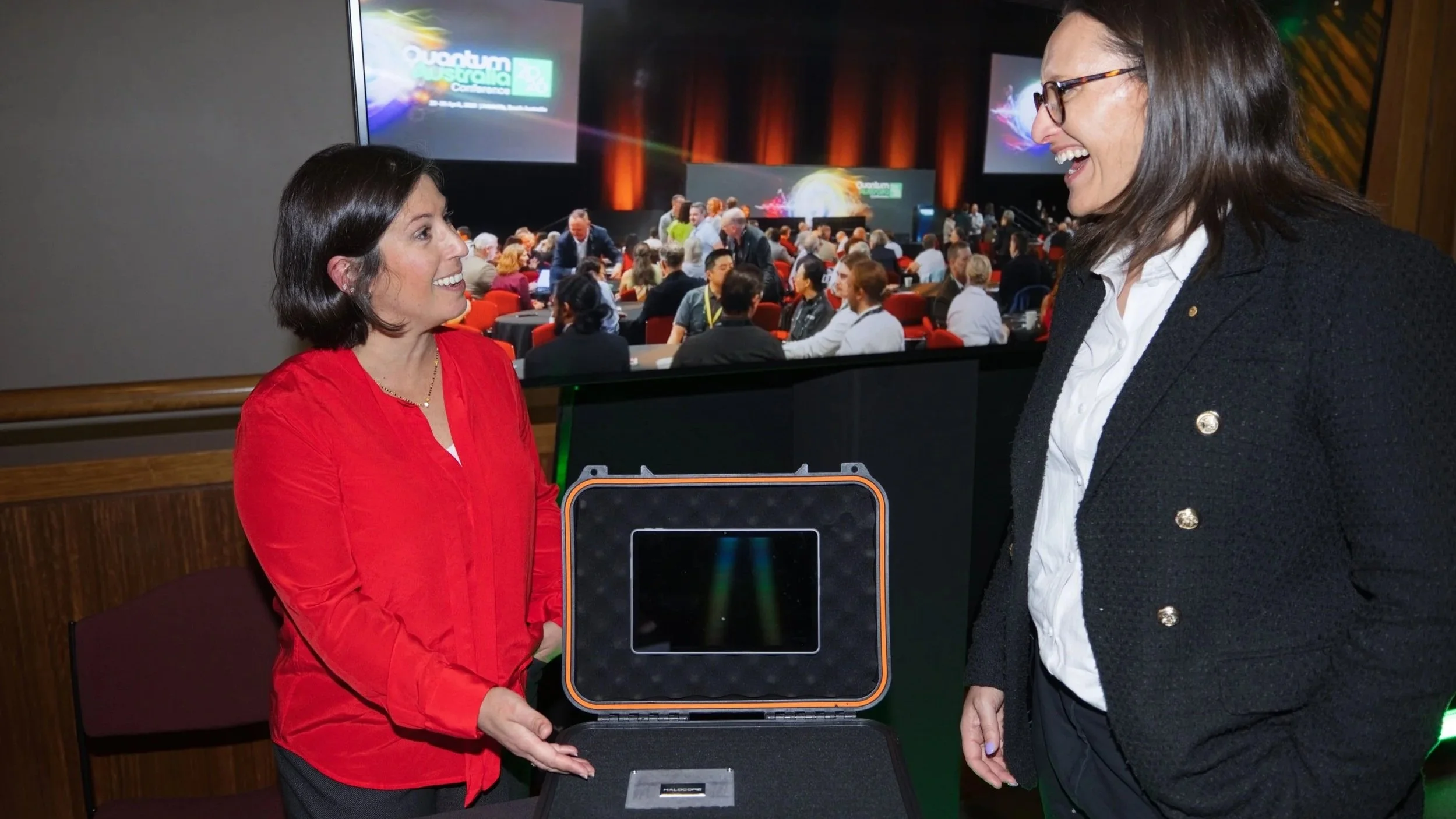
Space CoLAB Founder & CEO Carley Scott (left) and COO Amrit Bagia (right)
Space CoLAB is building a quantum communications platform designed to make eavesdropping not just difficult, but physically impossible.
Its flagship system, HaloCore, links two transceiver units, each about the size of a large briefcase, up to 10 kilometres apart, a range built as much for the battlefield as for a data centre. The Geelong-based startup is positioning the technology as a future AUKUS Pillar Two capability, alongside early interest from critical infrastructure operators in Australia and overseas.
It was over dinner, sometime last winter, that Ami Bagia stopped mid-bite, stunned by what she was hearing. Across the table, her friend Carley Scott, who had built Australia’s first commercial spaceport from the ground up, was casually describing what she’d been working on.
Bagia, a former US intelligence officer who had spent the first two years of the Biden administration at the White House National Security Council, understood immediately: a way to make secure communications survive quantum computers, without the cryogenic cooling that had kept the idea locked inside laboratories for decades.
She went home and told her husband. “Oh my”, he said, “you must go build this thing.” Bagia left her job soon after.
That’s the system Scott had designed: one its founder believes can do something neither quantum key distribution nor post-quantum cryptography can manage — guarantee that if someone intercepts a transmission, they capture nothing usable at all.
A team built on shared scars
Scott and Bagia met roughly three and a half years ago at a defence innovation forum, not long after Bagia had arrived in Australia, and became friends on the spot. It was another three years before Ami joined Carley at Space CoLAB, but both had already spent careers living with the same problem from opposite ends.
Scott, an Order of Australia Medal recipient, was CEO of Australia’s first commercial spaceport, work that exposed her firsthand to how vulnerable secure communications could be.
Bagia’s path ran through the US intelligence community and then the National Security Council, working counter-foreign-interference policy. She sat on a task force supporting Ukrainian resistance forces after Russia’s 2022 invasion, where a secure communications failure showed her the stakes firsthand. “It was the difference between life and death,” she says, “for the intelligence assets — people — relying on it in the field.”
She left government soon after, moved to Australia and ran a consulting firm focused on US-China technology competition — the work that put her in Scott’s orbit. Space CoLAB Group was founded in 2023. The team spending time between their home base, and offices supported by their investor, Antler, in East Melbourne Victoria.
Protecting the cans, not the string
Hacking is already a multi-trillion-dollar drag on the global economy, and the coming of quantum computers capable of breaking today’s encryption only raises the stakes.
Scott explains the gap with a simpler picture: a message locked inside a box, sent down a wire. Quantum key distribution and post-quantum cryptography both focus on the lock — building a key, or a code, as hard as possible to pick. QKD adds another useful feature: it can tell you if someone was listening, before the message was sent. But a problem remains: an eavesdropper can sit on the line afterwards in your system, silently listening in. With post-quantum cryptography, it makes the same lock harder in the hope that future computing and AI won’t be able to crack it. A great solution, but there’s no guarantee that it will hold. And, neither approach protects the wire itself, which still carries the message as interceptable data.
The urgency is compounding: government resilience mandates, rapidly improving computing and ai capability, and hackers sitting undetected inside networks, often for months before discovery are pushing operators past incremental fixes.
The diamond difference
Scott’s route to a fix began with over 2,000 virtual modelling experiments, replicating the mathematics behind existing quantum communications approaches, including QKD, and confirming where those systems fail in real world conditions where users were needing them most – fibre free and lower power settings between satellites, ships and drones, and buildings in conflict zones.
Rather than accepting the field’s starting assumptions, she treated it as a whole of systems problem. “It’s like a cake mix,” she says. “All the ingredients were there, but they weren’t being mixed the right way.”
The result is something that extends beyond the published work of world-leading physicists: using lasers to create a quantum state inside nitrogen-vacancy (NV) centres in lab-grown diamond. The resulting communications is laser fast, room temperature, tamper evident and harvest proof. That means, tampering with the information doesn’t just alert the system, it collapses the state and destroys the information — an interception leaves no message to steal, let alone store for later.
Just as significant is what the approach removes: cryogenic cooling, which often confines NV-diamond systems to laboratory conditions. Without cryogenics, the technology can move into the field, including the space settings Scott built, and the contested environments Bagia spent a career worrying about.
From virtual model to fielded hardware
Pre-seed backing from Antler, secured late last year, let Space CoLAB begin sourcing and growing diamonds to spec and move into fabrication, partnering with Australia’s National Fabrication Facility network delivering techniques to Space CoLAB’s recipe. Some of the highest risk techniques were trialed successfully on preliminary substrates earlier this year, confirming the techniques, and the company is now closing a further round to continue the process.
That rooftop-to-rooftop reach fits a military base linking to a forward base just as well as a utility’s head office linking to a remote plant. Interest from critical infrastructure operators — energy, water, banks — has moved faster than the defence requirements Space CoLAB designed around, and the company is sprinting toward a pilot to meet that demand.
Space CoLAB is an AUKUS authorised user to hold technical talks across the US, UK and Australia under the alliance’s Pillar Two. Talks are underway in all three countries, aiming for HaloCore to become a shared allied capability — including, Scott says, the ability to stand up a secure link for a training exercise, then take it down without providing a partner nation access to national infrastructure.
For people who spent their earlier careers watching secure communications fail at the worst possible moments, it’s a fitting kind of ambition: not just a harder lock, but a system built so there is nothing left to pick.
Related articles