Startup Spotlight: QFactorial
The fastest route or the best? QFactorial is building logistics software that aims for both
Quantum-ready optimisation software, delivering value on classical computers today and designed for the quantum hardware coming next.
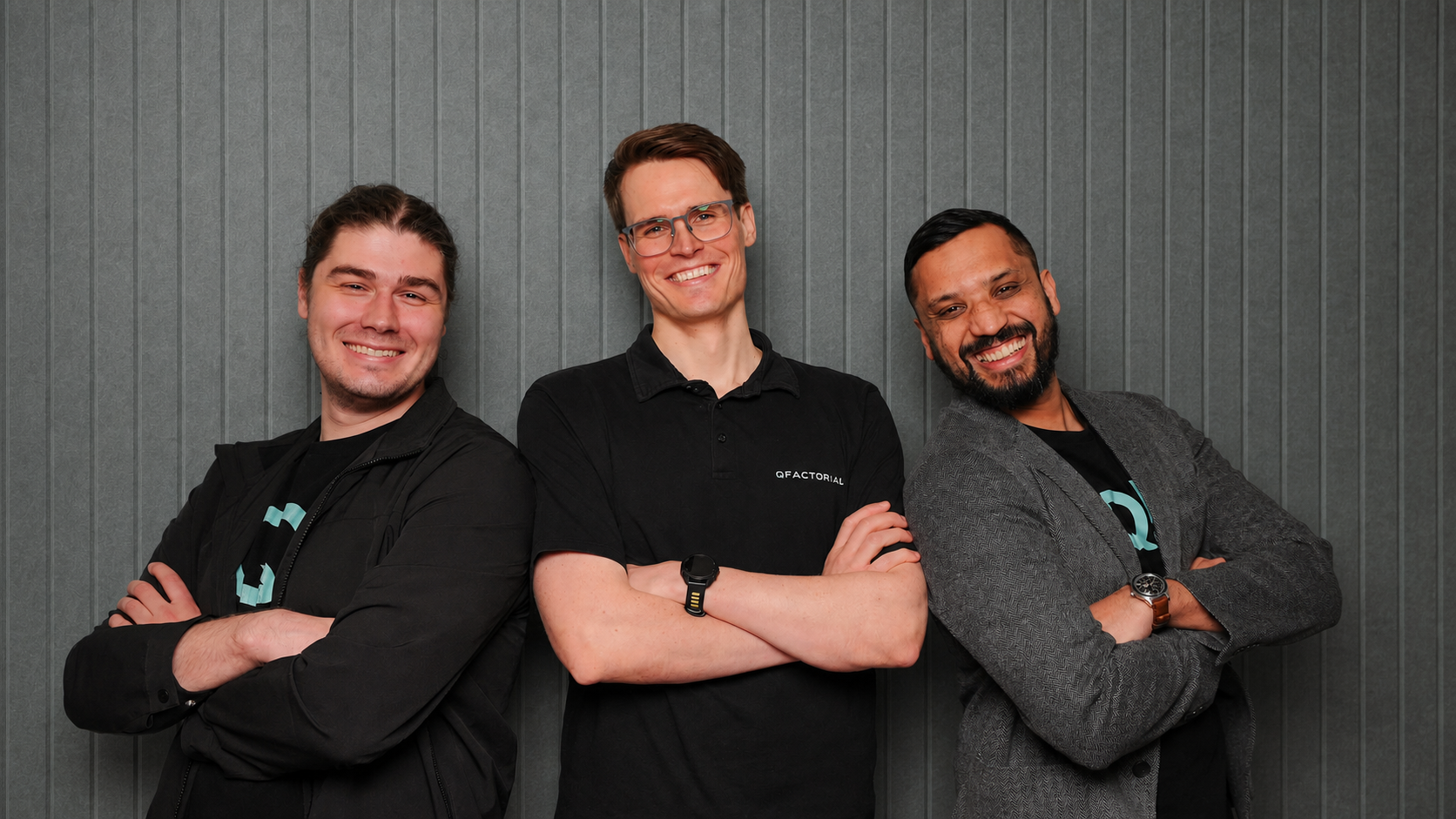
QFactorial
A truck is loaded, a route is planned — and then a machine breaks down, or an urgent order lands, or a delivery window moves. Logistics runs on decisions made against the clock, whether the job is online deliveries, just-in-time manufacturing or resupplying troops.
Organisations are constantly balancing the time available to make a decision against the quality of the solution: wait longer for the computer to search for a better plan, or act quickly on one that may leave value on the table?
QFactorial is developing optimisation software designed to shift that balance. Its platform runs on classical computers today, while providing a pathway to incorporate the company’s quantum heuristics as suitable hardware becomes available.
The company started with an engineer’s instinct to see an idea built. Before moving into quantum research, co-founder Tavis Bennett worked as a civil engineer, where the satisfaction lay in watching a design take physical form. During his PhD he developed a new framework for quantum optimisation, and wanted to take it on the same journey — from abstract idea to technology that solves real problems.
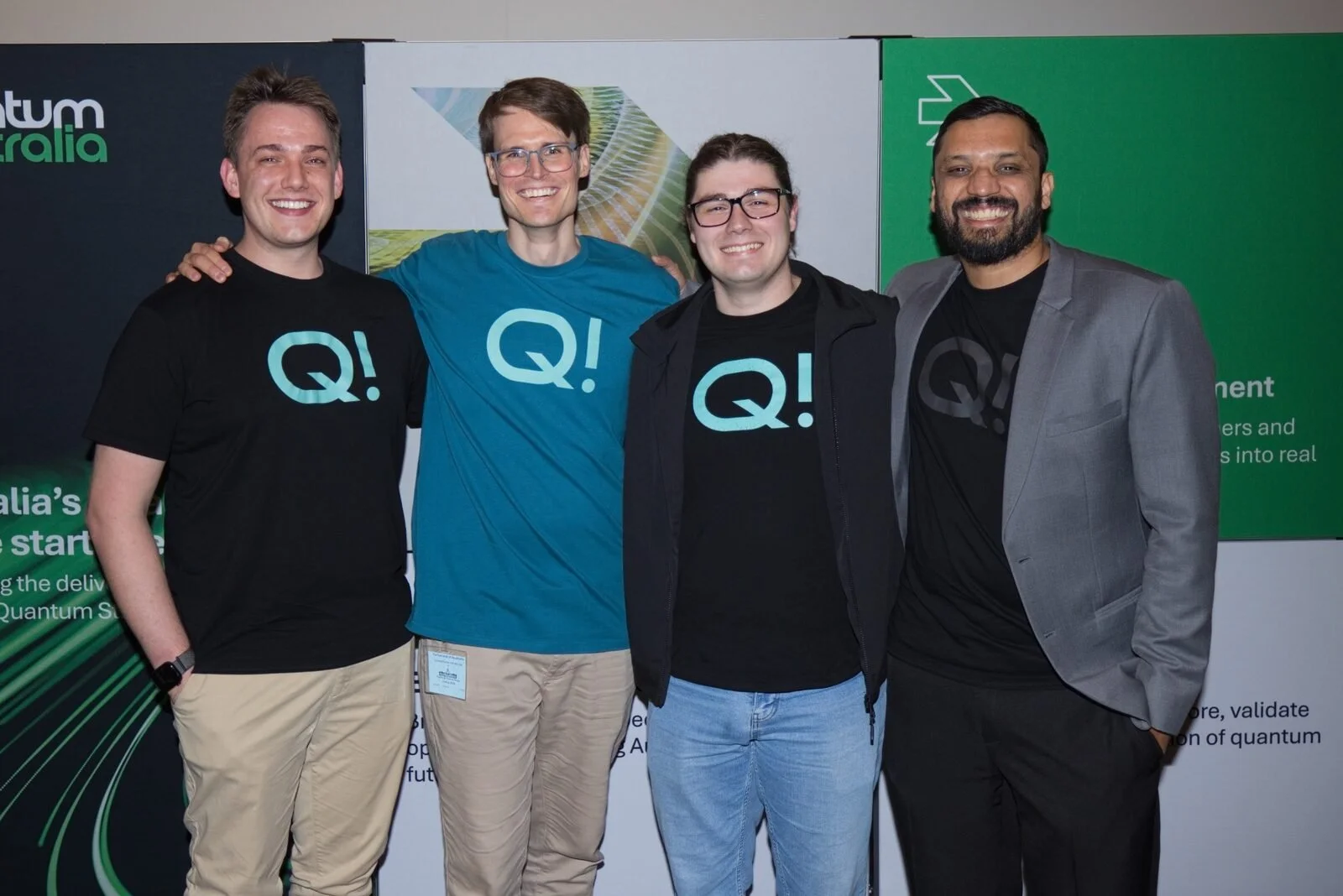
Co-founder Sharan Nambiar arrived from the other direction. At a Quantum Australia event, he watched large enterprises describe their curiosity about quantum computing with no idea where to start, while researchers presented deep academic work with no path to commercialise it. QFactorial, founded with Jayden Bradshaw, was built to sit in that gap and to give Australia a role in an industry it has the research to lead.
That research, and the core intellectual property behind it, is what drew investors. The founders met deep-technology backers at the 2025 Quantum Australia Conference in Brisbane; those conversations led to further introductions, a term sheet by May and a completed pre-seed round by July.
The speed–quality trade-off
QFactorial builds optimisation software for planning and scheduling where high-quality decisions have to be made quickly — the first plan of the day as much as the fifth revision of it. A manufacturer moving palletised goods by truck needs an initial delivery plan fast, and a new one the moment a machine breaks down. The same pressure runs through defence logistics, where “last-mile delivery” becomes “last-mile resupply”.
That mix of time pressure and operational consequence is why last-mile logistics is the company’s first commercial focus. Australian freight and manufacturing run on lean margins, exposed to fuel costs, labour shortages and disruption, so even modest gains in routing land squarely on profitability.
The difficulty is well documented. QOBLIB, an international benchmarking library built to compare classical and quantum methods and track progress towards quantum advantage, sets out 10 hard classes of optimisation problem. One is the capacitated vehicle routing problem, the challenge at the centre of QFactorial’s work.
Exact methods can certify the best possible answer, but on large problems the time required becomes impractical. Heuristics are much faster, often very strong, but generally cannot prove that nothing better exists. QFactorial’s ambition is to use quantum computing to fundamentally shift that frontier — to find the best solutions within the time real decisions allow — an opportunity its research suggests grows as problems get larger and more interconnected.
Classical value today, quantum capability tomorrow
QFactorial describes its product today as “quantum-ready” rather than quantum. Its solvers run on classical hardware, but the whole surrounding stack — data ingestion, constraint modelling, pre-processing, optimisation orchestration and output — supports both classical and quantum heuristics, and the company is already validating quantum execution pathways on real hardware.
The point, Bennett says, is that when quantum hardware becomes technically and economically useful, customers won’t need to reintegrate with a new product: the capability can be introduced progressively within the platform they already run. That platform is deliberately a scalable product rather than a series of one-off projects, built to fit existing operations and work for planners with no data-science team behind them.
On the quantum side, QFactorial is developing its heuristics for gate-based processors rather than quantum annealers. Annealers natively solve problems expressed as interacting binary choices, and can need substantial reformulation when decisions are not binary or relationships are complex. Gate-based processors, the founders argue, are a more flexible foundation for the problems QFactorial targets and for the algorithms that become possible as hardware matures.
“Building quantum annealing devices is like building for BlackBerry devices in the early 2000s,” Nambiar says. “They’ll do the job, but you know there’s a smartphone revolution coming.”
Two design choices set the company’s heuristic apart. It is non-variational, avoiding the heavily parameterised tuning loops many gate-based approaches rely on: a single compiled circuit, executed 1,000 times, which limits runtime and the cost of quantum hardware.
The second is representation. Conventional methods translate routing and scheduling into a much larger set of yes-or-no choices, and as problems grow, valid solutions occupy an exponentially smaller share of that inflated search space — which is why they struggle to scale. QFactorial’s approach works directly over the space of candidate solutions, keeping the search on meaningful possibilities and requiring dramatically fewer qubits than conventional QUBO-based encodings.
From the lab bench to the loading dock
The company has deliberately avoided committing to a single hardware provider. It is a member of the IBM Quantum Network and uses Amazon Web Services’ Braket platform to test its algorithms across multiple vendors’ systems. Because its heuristics are not tied to one manufacturer, it can back a different architecture as the field moves.
Its biggest recent milestone has been bringing together industry and research partners to demonstrate the technology in real logistics operations, spanning palletised freight and high-volume parcel delivery — the step from promising algorithms to software shaped by the pressures of an operating business.
The near-term focus is to prove the platform in logistics before extending it to job scheduling, resource allocation and rostering. As quantum hardware matures, QFactorial plans first to demonstrate its heuristics on increasingly challenging problems, showing what quantum optimisation can achieve even before running it is commercially practical. Quantum execution would move into operational use only where it is viable and improves on classical methods.
Related articles