The quantum race is global. Our future depends on keeping up
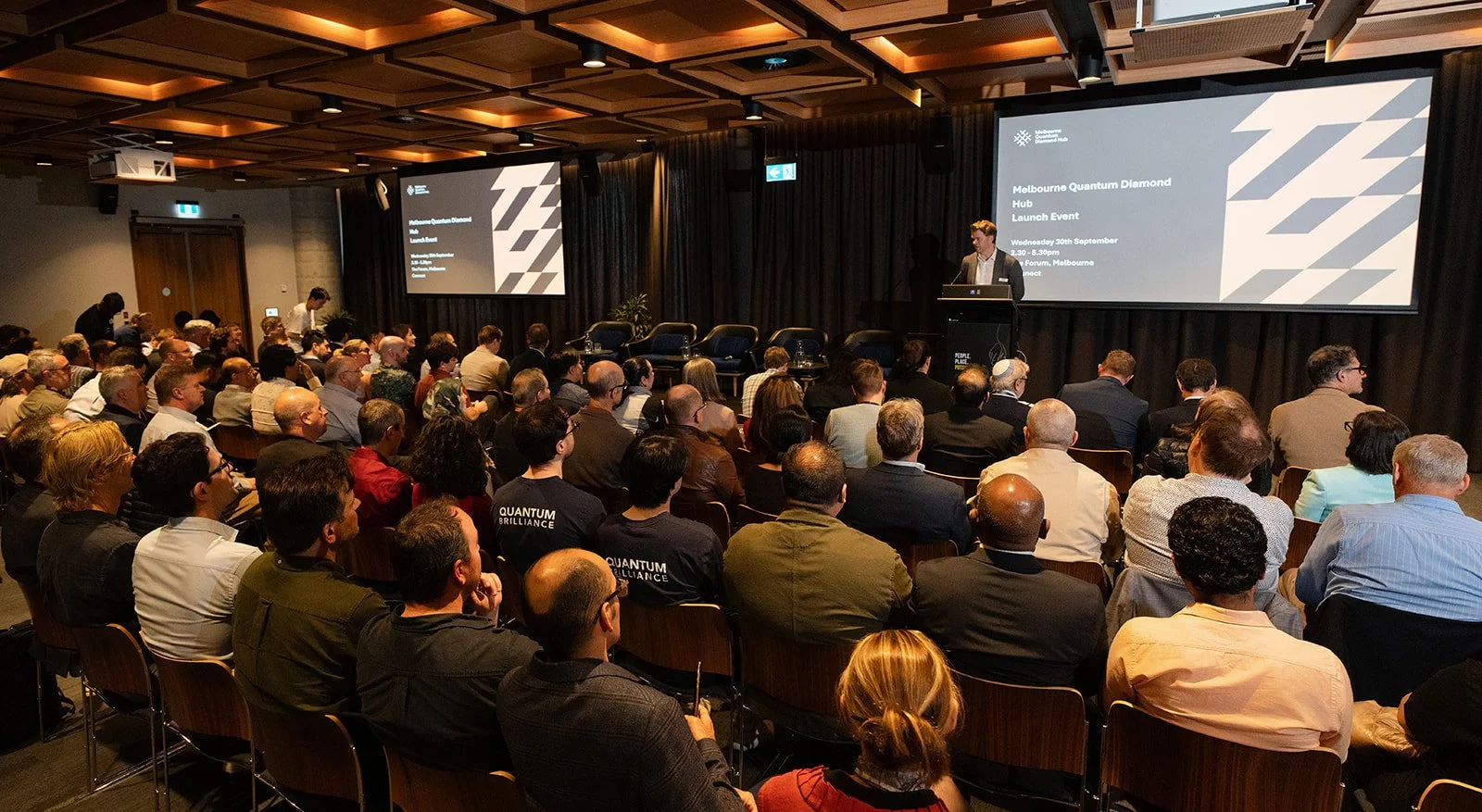
Quantum technology is no longer a distant scientific promise, according to the international leaders who travelled to Australia for the recent annual Quantum Australia Conference.
As was shown on stage during the conference, a broad range of quantum technologies and their industry applications are being treated as a strategic economic capability around the world.
Representatives from Finland, France, Germany, Japan, Italy, the Netherlands, the United Kingdom, and the United States did not take the time and resources to come simply to discuss research.
Instead, these international delegations came to compare national strategies, build commercial partnerships, and advance the industrial ecosystems their governments have been actively backing for many years as a means to shape national competitiveness, security, industrial resilience, and productivity.
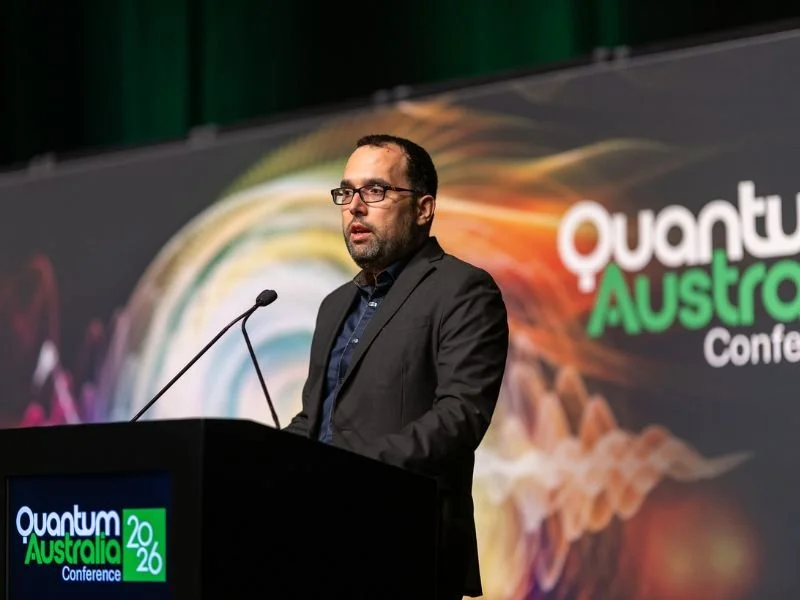
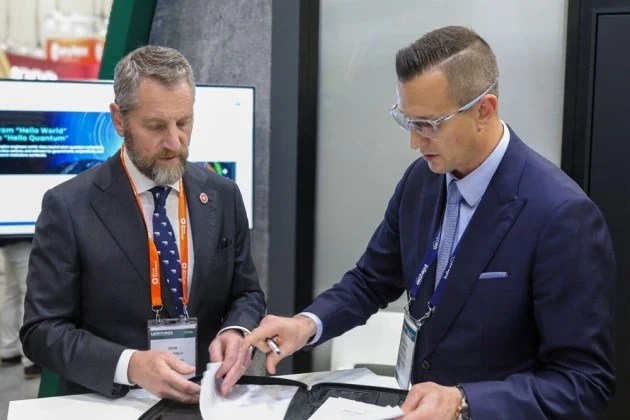
Dr Neil Abroug, Head of Quantum at France’s National Institute for Research in Digital Science and Technology (INRIA). Photo credit: InnovationAus
Their presence is a clear signal to Australia: leading economies understand the economic potential of quantum as a strategic enabling technology with the potential to shape future competitiveness, productivity and industrial capability across a range of critical industries.
These leaders know that the countries that build capability now will not just produce new computers, sensors and secure communications systems. They will also anchor advanced manufacturing, attract capital, grow deep technical workforces, and shape the supply chains of the future.
Like electricity, semiconductors and AI before it, quantum is an enabling technology. Its value lies not only in the industries that produce quantum systems, but in the productivity gains it can unlock across many other sectors. Countries therefore compete not simply to invent quantum technologies, but to capture the industries, investment and capabilities that grow around them.
Australia has the ingredients to be one of those countries.
On the one hand, we have world-class research, globally-respected scientists, emerging companies, and strong international relationships.
On the other, we also have significant opportunities to apply quantum technologies across sectors where Australia already has competitive advantages, including resources, energy, healthcare, agriculture, defence and financial services, strengthening the capabilities that will underpin future productivity, resilience, and economic growth.
Connecting these to form true strategic capabilities would help us to meet the Future Made in Australia vision: building sovereign industrial strength, creating high-value jobs, and ensuring the next generation of critical technologies is not simply imported, but shaped here.
Treasury describes Future Made in Australia as a plan to build a stronger, more diversified, and more resilient economy by attracting investment in key industries.
The question now is how quickly and effectively Australia can convert its quantum capability into lasting economic value.
How other countries are turning ambition into action
The common theme from our international counterparts on stage at the Quantum Australia Conference was that ambition was matched by execution.
Each speaker described a different national model, but together they showed that quantum is being treated as an economic, industrial, and sovereign capability, not just a research priority.
Importantly, the focus is no longer solely on developing quantum technologies themselves, but on applying them to strengthen productivity, competitiveness and resilience across the broader economy.
France has grown from two quantum startups in 2019 to around 50 companies today, with several now competing globally according to Dr Neil Abroug, from INRIA and a member of the European Strategic Advisory Board for Quantum Technologies.
Dr Abroug told the conference that France launched its national quantum strategy in 2021, backed by around a billion euros of public investment over five years.
He said the strategy spans basic research, quantum computing, quantum communications, quantum cryptography, post-quantum cryptography, and enabling technologies. He also explained that France’s approach has extended beyond laboratories into industrial capability, including national capacity in silicon-28, a key material for some quantum technologies, and cryogenics capability for future quantum-ready data centres.
The United Kingdom has also moved decisively.
Jonathan Legh-Smith, executive director of UK Quantum, told the conference that the UK’s national quantum strategy sets out a 10-year vision for the country to become a world-leading quantum-enabled economy.
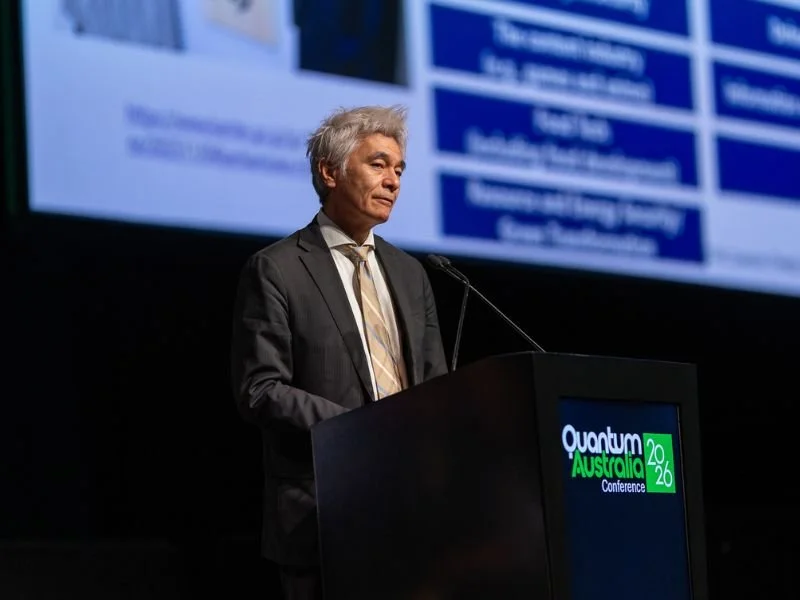
Q-STAR Japan’s Katsuyuki Hanai. Photo credit: InnovationAus
He said the UK government has committed up to 2 billion pounds for quantum technologies, including one billion between 2026 and 2030 across quantum computing, quantum sensing, quantum networking, skills, infrastructure, and international partnerships. Crucially, the UK has also signalled up to a billion pounds for the procurement of large-scale quantum computers from 2030, subject to the success of the next phase of its program.
As outlined by Legh-Smith, the UK approach is not just a funding program, but a procurement-led pathway that moves from company evaluation, to machine delivery, to large-scale procurement. In practical terms, that tells companies there will be customers, not just grants. It gives investors confidence. It encourages suppliers to scale. It helps turn science into industry.
Japan is taking a similarly industrial view.
Katsuyuki Hanai, from Q-STAR Japan, told the conference that Japan’s quantum strategy is built around three pillars: research, vision, and industry, with a strong focus on connecting quantum technology to economic and social value.
He said Q-STAR, Japan’s quantum strategic industry alliance, has 156 members, including 77 user-side members. He also made the point that technology alone does not create markets, users do. That observation is particularly relevant for Australia, where the opportunity is not simply to build quantum technologies, but to embed them within industries where Australia already has global strengths
The United States, meanwhile, continues to combine federal investment, national laboratories, major technology companies, defence and security buyers, venture capital, and regional innovation clusters.
George Thomas, president and CEO of Connected DMV, told the conference that the US National Quantum Initiative spans 17 agencies, with additional investment flowing through agencies including the Department of Energy and the Department of Commerce. Speaking about the greater Washington region, he said it includes more than 100 US federal laboratories, 11 quantum-dedicated centres, and a major concentration of aerospace, defence, biotech, cybersecurity, and national security buyers.
Each country is taking a different route. But the common thread from all speakers was clear: quantum is being treated as a whole-of-economy capability, not a niche research discipline.
Australia’s opportunity is real
Australia’s opportunity is unusual. We possess internationally recognised quantum research while also having globally competitive industries, including mining, energy, agriculture, defence and financial services, that stand to become early adopters of quantum technologies. That combination is comparatively rare.
But scientific excellence is not the same as sovereign capability. A promising startup ecosystem is not the same as a scaled industry, and a strategy is not the same as delivery.
The Future Made in Australia agenda recognises that national prosperity will increasingly depend on our ability to build industries of strategic importance at home. Quantum should be considered an integral part of that agenda, not adjacent to it.
If Australia gets this right, quantum can become a major pillar of our future economy. It can support high-value jobs, grow exportable intellectual property, strengthen national security and create new tools for industries where Australia already has global strengths.
Quantum sensing could improve navigation, medical imaging, mineral exploration and environmental monitoring. Quantum communications and post-quantum cryptography will play an important role in future cybersecurity. Quantum computing has the potential to transform optimisation, materials discovery, logistics, drug discovery, and financial modelling.
These are the areas where global markets, strategic partnerships, and national interests are already forming.
They are the kind of high-value, capability-building opportunities Australia could capture if we wish to do more than just manufacture what the world already makes.
To truly build a Future Made in Australia means building the new suite of technologies that will define the next industrial era.
Lessons for Australia
The experience of the countries represented at the Quantum Australia Conference suggests several common ingredients for building a globally competitive quantum industry.
For Australia to act with this same level of seriousness would begin with long-term policy certainty.
Most Quantum companies operate on timeframes that do not fit short political cycles so they need confidence that national priorities, funding programs, and procurement pathways will endure.
Secondly, it would take shifting from research support alone to industry creation.
That means backing scale-up pathways, manufacturing capability, shared infrastructure, standards development, and export readiness. This is central to building the kind of resilient, sovereign industrial base Future Made in Australia is designed to support.
Thirdly, we would see government become an early and intelligent customer.
Procurement is one of the strongest tools available to accelerate emerging industries. Australia could identify priority national use cases where quantum technologies can solve real public sector and sovereign challenges, then create pathways for local companies to demonstrate, validate and scale.
Fourthly, we require a national talent plan.
Every country represented at the conference raised skills, directly or indirectly. Australia will need quantum physicists, engineers, software developers, technicians, product leaders, commercial specialists and end users who understand how to apply these technologies in real settings.
Finally, we need deeper international collaboration without surrendering our own advantage.
No country will build the entire quantum stack alone, but the countries that bring clear capability, coordinated strategy, and credible companies to the table will shape the partnerships. Those that do not will become customers of someone else’s technology.
The positive news is that Australia is well positioned to play a meaningful role in shaping the future quantum economy.
But that opportunity will not be realised by assuming our research strength will automatically turn into economic strength.
Other countries are making deliberate choices investing now because they understand what is at stake. Quantum will influence who builds the next generation of secure infrastructure, advanced industries, and high-value companies.
The global quantum race is no longer about who publishes the best science, but who builds the companies, develops the workforce, captures the supply chains and creates the industries that follow.
Australia has many of the ingredients. We must now focus our ambition on turning them into enduring national advantage.
Related articles