Good sense: Turning diamond dust into quantum advantage
CSIRO is turning low-value diamond ‘dust’ into high-performance quantum materials that can detect tiny magnetic signals, unlocking powerful new approaches to chemical and biomedical sensing. Via CSIRO
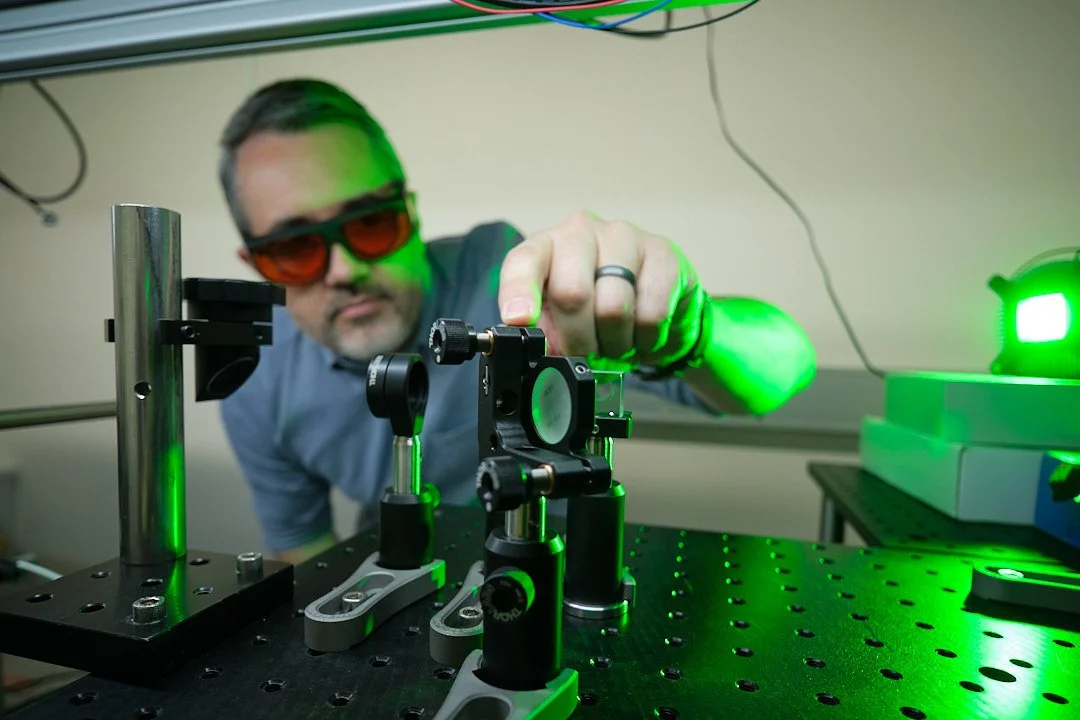
Image credit: CSIRO
Diamonds have long been coveted for their beauty. Their dazzling colour and clarity make them perfect candidates for luxury jewellery. However, it's their other unique characteristics, including their hardness, thermal conductivity and chemical resistance, which make diamonds suitable for various applications in industry and advanced technologies.
At the quantum scale, carefully engineered diamonds can behave like tiny sensors – able to ‘feel’ magnetic signals from nearby molecules. In simple terms, they can pick up incredibly faint signals that would otherwise be invisible to conventional instruments. This capability could help us detect contaminants in water, identify disease biomarkers, and monitor chemical processes in real time.
A CSIRO team, together with partners from the University of Melbourne and Japan’s National Institute for Quantum Science and Technology (QST), is developing advanced manufacturing methods that take diamond ‘dust’ – tiny particles sourced from cheap industrial processes – and transform it into precision nanodiamonds suitable for quantum technologies.
The team’s goal is to develop a scalable, lower-cost pathway to quantum-grade diamond materials that can be produced locally. This will advance Australia’s critical quantum technologies, strengthen regional innovation capability, and reduce our reliance on unpredictable global supply chains.
Born in the lab, built for the field
Phasor Quantum was established in 2023 as a spin-out from Phasor Innovation in collaboration with two of Australia's leading research institutions, the University of Melbourne and RMIT University. The founding team is a carefully assembled blend of deep scientific expertise and hard-nosed defence industry experience.
CEO Adam Silvester brings more than 25 years of engineering and R&D leadership in defence. CTO Andy Sayers matches that with equal time working in RF electronics and applied physics. On the science side, Associate Professor David Simpson of the University of Melbourne has spent more than 15 years in nitrogen-vacancy (NV) diamond research, while Professor Brant Gibson of RMIT brings more than two decades in quantum sensing and photonics. It is, by any measure, an unusually well-credentialled founding team for an early-stage company.
Their shared mission was to pull quantum diamond sensing technology out of the laboratory and put it to work in the real world.
What makes a diamond 'quantum'?
Let’s get technical for a moment.
A diamond’s structure is formed by a lattice of carbon atoms. In this crystalline structure each carbon atom is bonded to four others in a tetrahedral arrangement, forming a rigid 3D network. Quantum-grade diamonds contain specific atomic-scale ‘defects’ in this lattice, that allow for the creation of quantum systems. And because they are one of the strongest structures in nature, diamonds are able to host quantum systems at room temperature, without needing to be cooled down to cryogenic temperatures (-273 degrees C) like in other materials.
Shine bright like a diamond
One of the most useful of these ‘defects’ is known as the nitrogen-vacancy (NV) centre. This occurs when one carbon atom is replaced by a nitrogen atom and a neighbouring carbon atom is missing in the lattice.
When we shine green light on an NV centre, it fluoresces, or glows red. The brightness and behaviour of this fluorescent glow changes depending on the surrounding environment, such as magnetic fields, electric fields, temperature or strain. By measuring these changes, scientists can use NV centres to act as a nanoscale sensor.
But making good NV centres, particularly near the diamond surface where they can detect what’s happening outside the crystal, isn’t straightforward.
The process typically involves blasting the diamond with radiation to create vacancies (essentially bumping out some of the carbon atoms), then heating it so those vacancies are adjacent to nitrogen atoms to form NV centres.
For nanodiamonds, the surface matters just as much, because the outer layer has a huge impact on how stable, bright and sensitive the NV centres are.
Related articles