Start-up Spotlight: Phasor Quantum
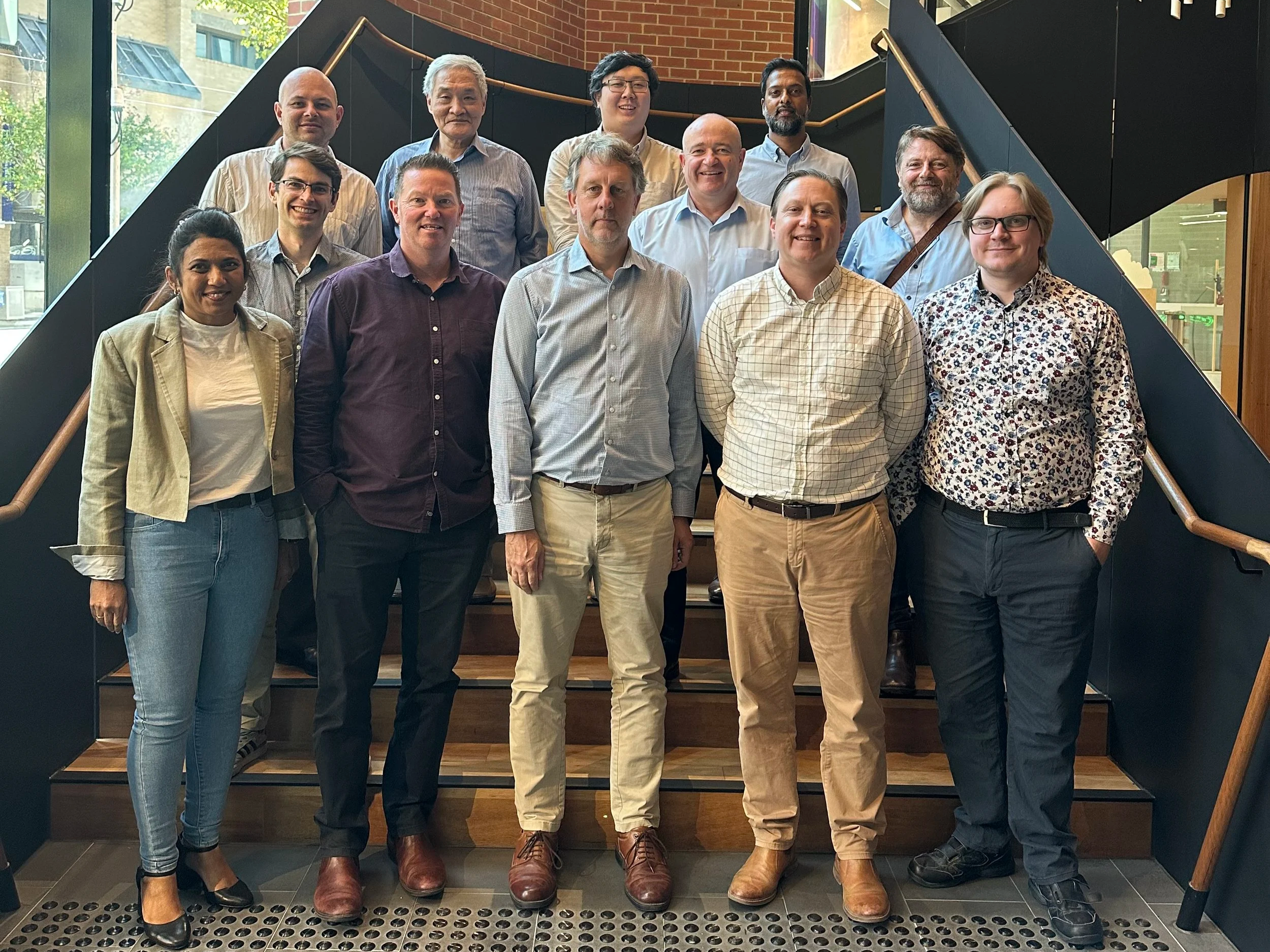
Photo credit: Phasor Quantum
Reliable, secure navigation everywhere with diamond-based quantum sensors.
On a clear day somewhere over Australia, a defence aircraft was quietly making history. Tucked inside its fuselage was a small metal box branded with a blue heartbeat logo — a prototype sensor built by a then-nascent Australian start-up. Over more than 8,000 kilometres of flight trials, that device demonstrated something that had never convincingly been done before: precise, drift-free navigation without GPS.
The company behind it is Phasor Quantum and, if its founders are right, the technology inside that box could fundamentally change how military and civilian planes, ships, submarines and underwater vehicles find their way through the world's most contested and challenging environments.
Born in the lab, built for the field
Phasor Quantum was established in 2023 as a spin-out from Phasor Innovation in collaboration with two of Australia's leading research institutions, the University of Melbourne and RMIT University. The founding team is a carefully assembled blend of deep scientific expertise and hard-nosed defence industry experience.
CEO Adam Silvester brings more than 25 years of engineering and R&D leadership in defence. CTO Andy Sayers matches that with equal time working in RF electronics and applied physics. On the science side, Associate Professor David Simpson of the University of Melbourne has spent more than 15 years in nitrogen-vacancy (NV) diamond research, while Professor Brant Gibson of RMIT brings more than two decades in quantum sensing and photonics. It is, by any measure, an unusually well-credentialled founding team for an early-stage company.
Their shared mission was to pull quantum diamond sensing technology out of the laboratory and put it to work in the real world.

Image credit: Phasor Quantum
The problem hiding in plain sight
To understand what Phasor Quantum is building, it helps to understand the fragility of the infrastructure the modern world depends on for navigation. We all rely on GPS, the Global Positioning System, every day for navigation in our cars, on farms, in the air and for defence.
GPS is owned by the US government and is the biggest of several global navigation satellite systems (GNSS). These systems can be jammed, spoofed (where a malicious actor broadcasts counterfeit GPS signals), and in environments such as underwater or underground, it simply doesn't work at all.
The headlines tell a sobering story. In a single recent year, approximately 150,000 GPS loss-of-signal events were recorded affecting US aircraft according to the Federal Aviation Administration, while globally IATA estimates signal loss affects around 6 per cent of all flights. Container ships have run aground following spoofing incidents. A plane carrying a senior EU leader was targeted by alleged Russian jamming. GPS disruption has become one of the defining security challenges of the decade.
The conventional fallback uses accelerometers and gyroscopes. But these inertial navigation systems (INS) have their own critical flaw. These systems drift. The longer an aircraft, ship or vehicle operates without a GPS fix to correct itself, the more its position error compounds. Even the most expensive strategic-grade INS systems accumulate drift over time, with errors growing from metres to kilometres over the course of hours to days without external updates.
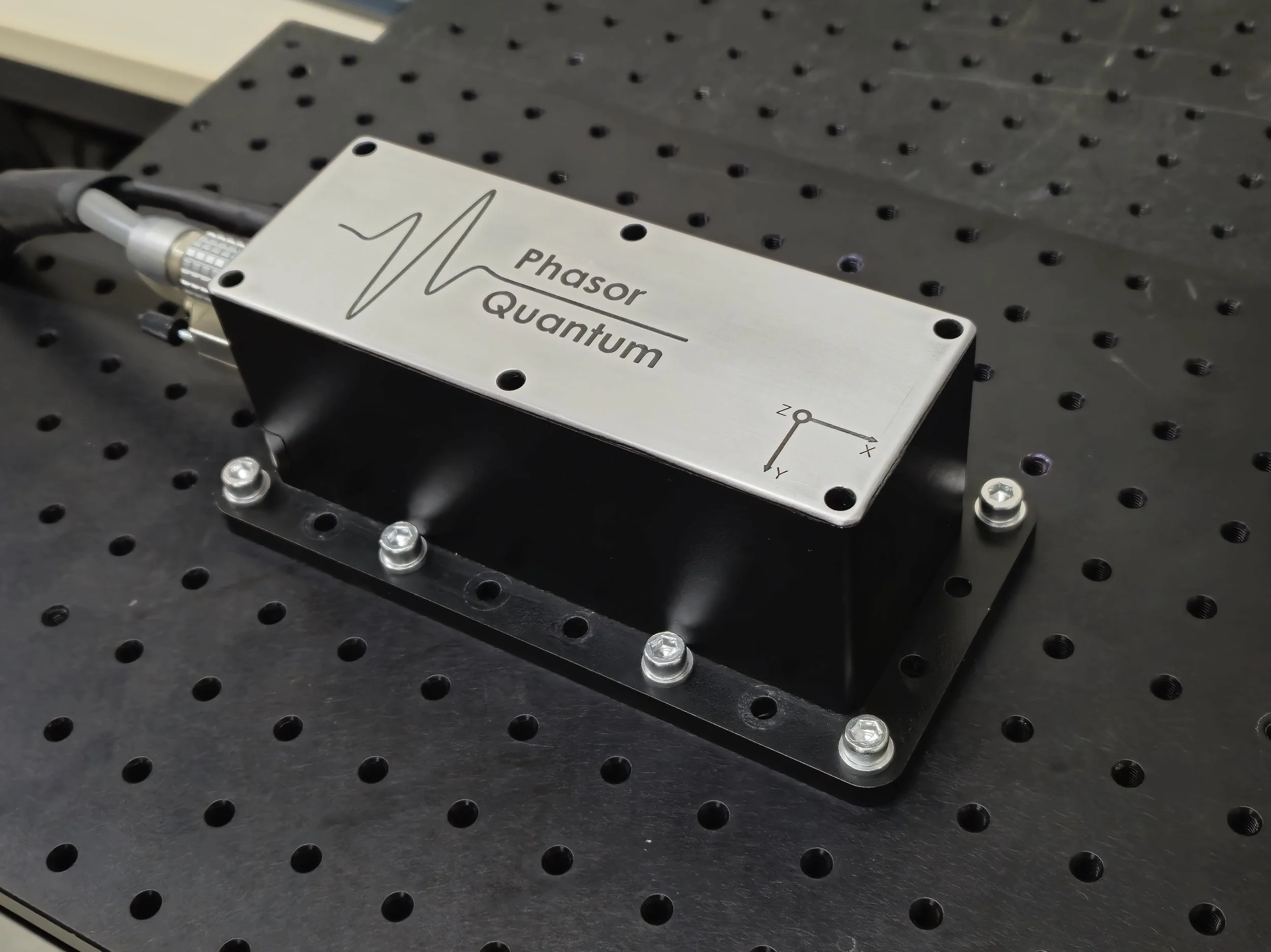
Image credit: Phasor Quantum
The diamond difference
Phasor Quantum's answer lies in using the quantum properties of an engineered synthetic diamond to precisely measure the strength and direction of the Earth’s crustal magnetic field.
The diamond crystals contain defects known as nitrogen-vacancy (NV) centres, which act as exquisitely sensitive quantum magnetic field detectors. Reading those NV centres in real time lets the sensor track the Earth’s magnetic field with precision as the aircraft moves, providing an always-available navigation reference that GPS cannot guarantee.
Most competing magnetic navigation solutions measure field strength only, not direction. Phasor's approach reads the full vector, giving navigators a significantly richer dataset to work with when matching readings against magnetic anomaly maps. Crucially, the company has filed a patent for a novel NV-diamond bias scheme that eliminates the drift and offset errors that have historically made vector magnetometry impractical for real-world navigation.
From prototype to service
The results from Phasor's airborne trial program, conducted with Australian Defence and allied defence stakeholders, validated the approach decisively. In flight data charts from the trials, the navigation error of the MagNav-aided system remains tightly bounded with only modest variation, while the INS-only equivalent increases steadily, reaching kilometres of error over the same timeframe.
Phasor is now evaluating its beta-prototype in trials across air, land, sea and undersea platforms. Autonomous underwater vehicles represent a particularly compelling near-term application — a domain where GPS is entirely absent and these underwater drones have to surface for accurate navigation. As part of this work, the company was just awarded a recent Defence Advanced Strategic Capabilities Accelerator (ASCA) Undersea Navigation Challenge, contract to rapidly prototype, develop and deploy their undersea navigation system.
The applications extend well beyond defence. Commercial and civil aviation operators face the same GPS jamming and spoofing incidents that increasingly disrupt scheduled flights, particularly around conflict zones and contested airspace, where a drift-free backup system could help keep passenger services on time and on route.
Global shipping and maritime freight stand to benefit in busy ports and congested shipping lanes, where spoofing has already caused container vessels to run aground. And the broader transport sector — from rail networks to autonomous trucking, port logistics and long-haul freight — depends on accurate positioning that is increasingly vulnerable to interference. In each of these markets, the ability to navigate reliably without GPS is shifting from a nice-to-have to a commercial necessity.
The company has secured approximately $10 million in funding to date, supported through Phasor Innovation and Australian Defence organisations across multiple projects. It is now preparing for a capital raise to enable team expansion, product maturation to support early customer evaluations, and progress toward pilot-scale production.
Many of the world's leading underwater vehicle and inertial navigation manufacturers have already reached out to explore integration opportunities. The conversation about what comes after GPS has begun and Phasor Quantum intends to be central to it.
Related articles