Startup Spotlight: Quantum Lock
Trust nothing, prove everything
A UNSW spin-out is planning to use entangled photons to prove that the computers running power stations and other critical national and defence infrastructure haven’t been compromised.
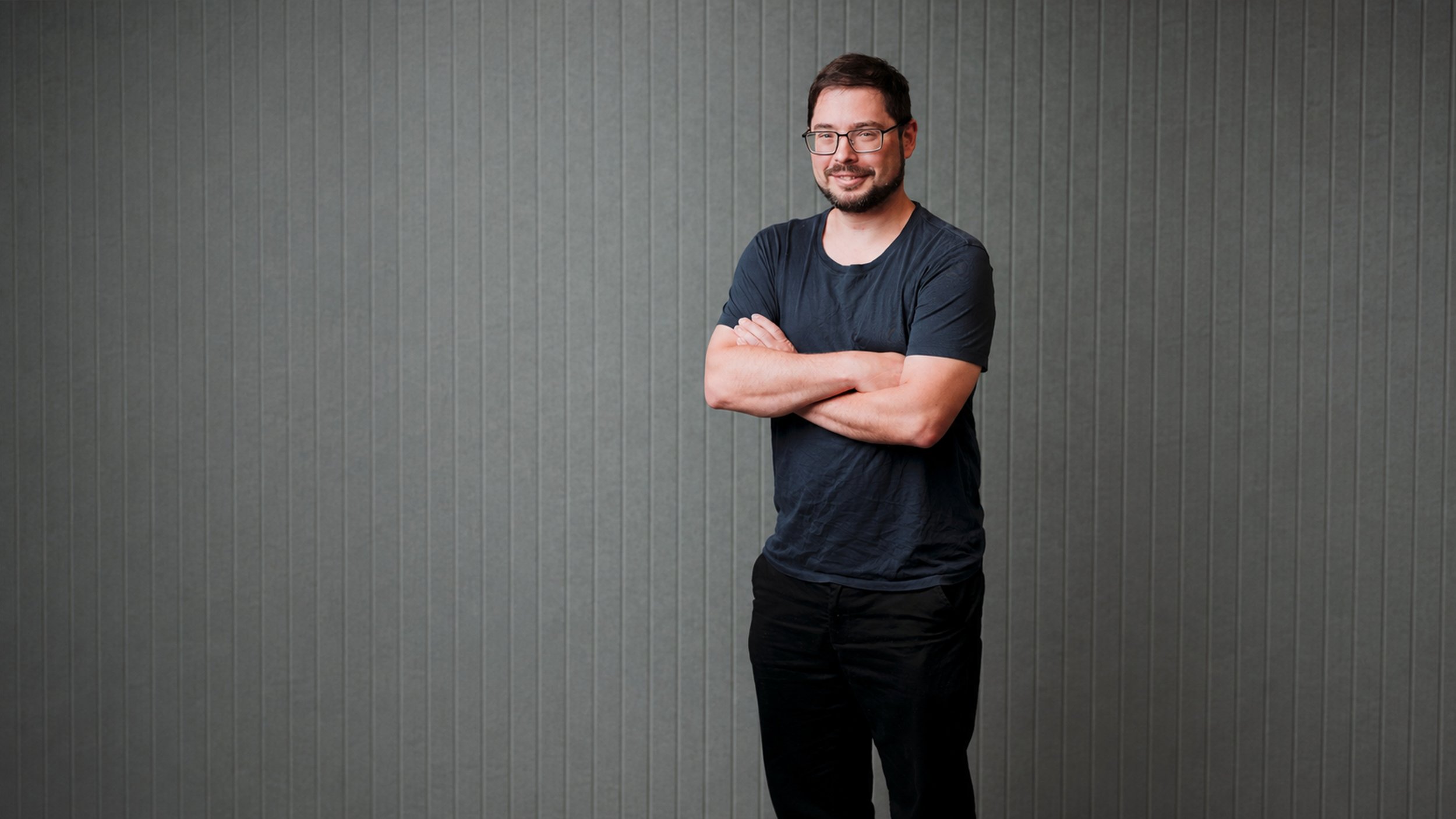
Dr. Jesse Laeuchli
For a few years in the United States, Jesse Laeuchli’s job was making sure secrets stayed secret. After a PhD in numerical linear algebra applied to physics, he went to work for the National Security Agency, where his maths background qualified him for cryptography training, alongside hands-on work in network operations — hacking, in lay language. A year at the CIA followed, in much the same vein.
It’s fitting, with hindsight, that Laeuchli would end up building a company around the one piece of physics Albert Einstein found almost offensive: entanglement, the phenomenon in which two particles remain correlated no matter the distance between them, and which Einstein dismissed as “spooky action at a distance”.
It is real, and decades later it has become the foundation of Quantum Lock, the UNSW spin-out Laeuchli founded to do something classical cybersecurity cannot: prove, rather than merely infer, that a piece of remote hardware hasn’t been compromised.
The company’s own pitch is blunt about the philosophy behind it: trust nothing, prove everything.
From cryptography to a UNSW lab
After leaving the NSA and the CIA, Laeuchli moved to Australia and a few years later joined UNSW, where he began looking for a problem that combined his two longstanding interests: cybersecurity and physics.
He found it in a deceptively simple idea. If a remote computer is entangled with the computer defending the network, the defender knows the instant anything changes.
Laeuchli developed the underlying protocol and prototype largely as an academic research project, publishing the results in Quantum Information Processing and IET Quantum Communication. Commercial manager Kieran Singh joined in the past few months to bring a business lens the founding science had been missing. Quantum Lock was incorporated in March 2025 as a staff-led UNSW spin-out based in Sydney.
Proving, not inferring
The computers embedded in critical infrastructure — a data centre, a power plant, a satellite — are routine targets for hackers, and there is no way for a classical computer to prove one of those devices is still safe. The best classical security tools can do is infer, through heuristics and statistical fingerprints: an educated guess built from signals that a sufficiently capable attacker, one who already controls the device, can forge just as easily as the operator can check them.
Quantum Lock’s pitch is that physics can close that gap. Its device is built to give operators a guarantee grounded in quantum mechanics rather than statistics: either the hardware is provably uncompromised, or an intrusion is caught immediately. The target customers are the operators for whom that distinction matters commercially as much as technically — power stations, telecommunications infrastructure and data centres, where even a minor breach can carry outsized financial and safety consequences.
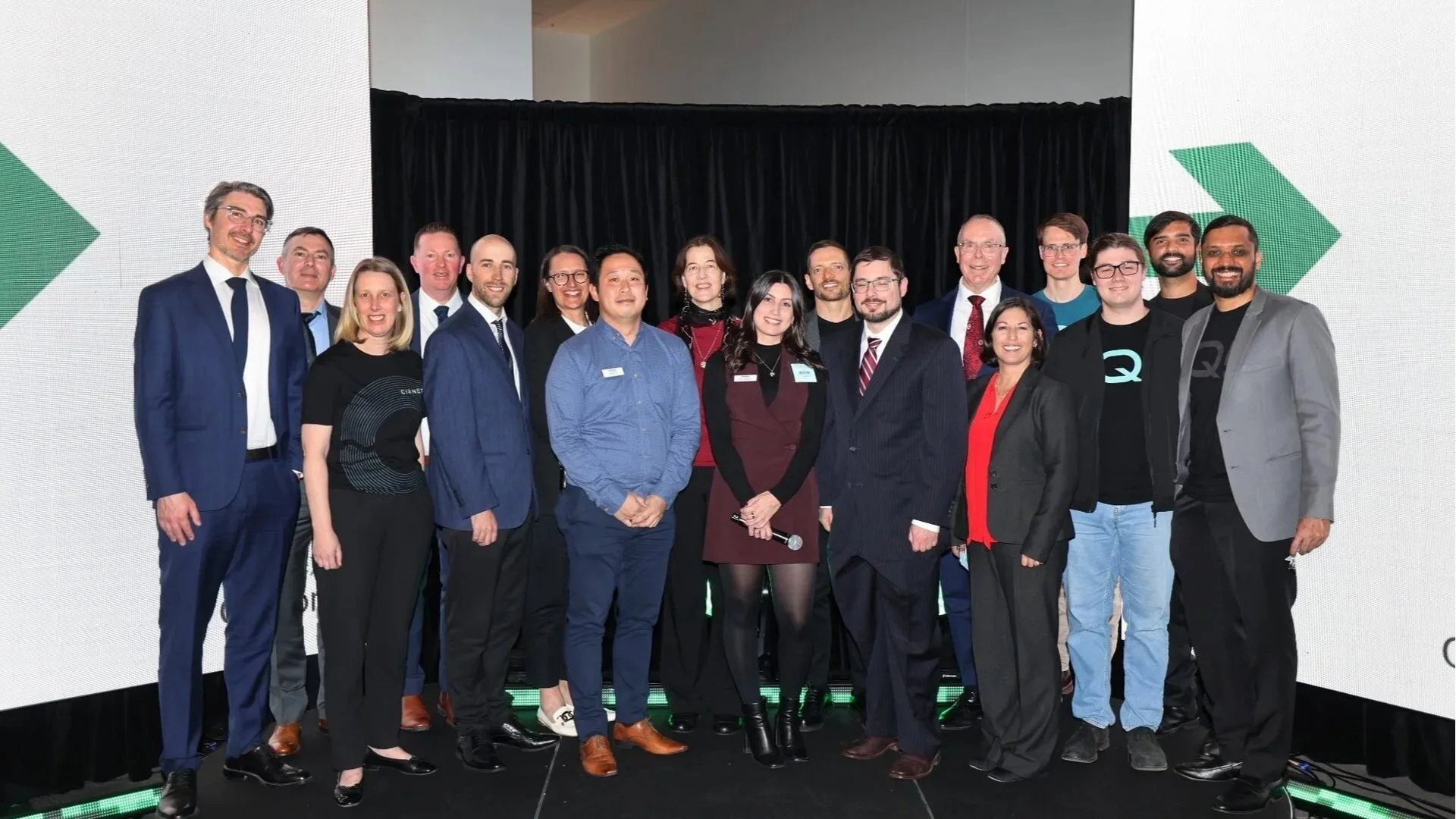
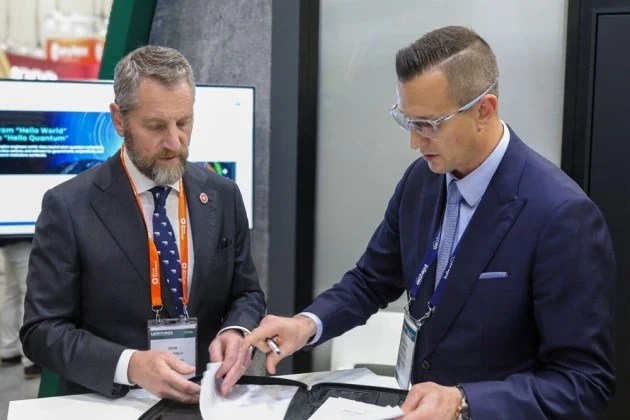
NextQ Cohort, Quantum Australia Showcase, Parliament House
Borrowing Einstein’s spooky action
Quantum Lock doesn’t use encryption. Quantum key distribution, the best-known application of quantum physics to cybersecurity, is about exchanging a secret key while trying to guarantee no one has intercepted it, but it still leaves a secret sitting there to be stolen, and it assumes the two ends of the exchange can be trusted in the first place. Quantum Lock starts from the opposite assumption: that the remote device may already be compromised, and sets out to prove, one way or the other, whether that’s true.
The protocol is built on quantum teleportation, itself a consequence of entanglement. A verifier — the defender’s system — and the remote device each hold one half of an entangled pair of photons. The verifier challenges the device to prove the state of a specific, randomly chosen region of its own memory. The device can only respond correctly using quantum correlations tied to what its memory actually contains, rather than a firmware report an attacker could falsify.
If even a single bit has been altered, those correlations break down and the deception shows up immediately. Because entangled quantum states cannot be cloned or forged, the proof holds even against an attacker with unlimited classical or quantum computational resources. The teleportation step also enforces a physical distance tied to the speed of light, which rules out a compromised device quietly relaying the challenge to an accomplice elsewhere to fake a correct answer.
None of this requires physics that doesn’t already exist. The protocol runs on entangled photon sources, single-photon detectors and fibre optics — commercially available components today — using shallow circuits of rotations and measurements rather than a fault-tolerant quantum computer.

Dr. Jesse Laeuchli
Out of the lab
The prototype in Laeuchli’s UNSW lab is suited to laboratory optics; the immediate task is making it work on the real-world fibre optic networks it would have to run on, at the 1550-nanometre wavelength those networks use.
Commercially, Quantum Lock is working under non-disclosure agreements with several large prospective users, spanning hyperscale cloud infrastructure and financial services, to co-design the product for their environments. It has made two submissions to Defence’s Advanced Strategic Capabilities Accelerator, including a bid to fund shrinking the device from a box down to a chip, and has received pre-seed funding through the Defence Trailblazer program.
Just over a year in, an academic side project chasing the gap between cybersecurity and physics is in conversation with some of the world’s largest technology and financial institutions. The claim it is making is an unusually absolute one for an industry built on probabilities: not that a machine is very likely to be safe, but that it can be proved.
Related articles