Startup Spotlight: GridState Photonics
GridState Photonics: using light to beat errors
A two-person Brisbane start-up is betting that the key to a useful quantum computer isn’t building more qubits — it’s needing fewer of them for every reliable one.
Gridstate Photonics
The race to build a useful quantum computer is, at its heart, a race against noise. Qubits, the fragile quantum bits that give these machines their power, lose their information almost as quickly as they can hold it, upset by the faintest heat, vibration or stray field.
The industry’s dominant answer, pursued by giants such as Google, IBM and PsiQuantum, has been sheer redundancy: lash hundreds or thousands of physical qubits together so that, collectively, they behave like a single reliable one. It is an approach that could eventually demand a million physical qubits and, for some architectures, a building full of hardware to house them.
In Brisbane, a company called GridState Photonics is taking a different route. Its founders are pursuing a different kind of photonic architecture, using error-correcting states of light that they believe could substantially reduce the number of physical resources needed for each reliable logical qubit.
Photons interact only weakly with their surroundings and can carry quantum information with little decoherence, and much of the optical circuitry can operate at or near room temperature — although photon loss remains a major source of error, and high-performance sources and detectors may still require cryogenic cooling.
Photonic quantum computing is already well beyond the whiteboard: chip-scale systems, modular networks, cluster states and fault-tolerant architectures have all been demonstrated or developed. But not every photonic architecture requires optical GKP states, and preparing those states reliably, at high enough quality and at speed, is the central bottleneck for the particular continuous-variable route GridState Photonics is pursuing. The company says it has worked out how.
From a Brisbane PhD
GridState Photonics is brand new, not only in approach but on the corporate scene. Incorporated in March 2026, the company is, for now, essentially two people: chief executive Peter Baines, who runs the commercial side, and Matt Winnel, the physicist whose research the company is built on.
The science traces back to Winnel’s PhD at the University of Queensland, conferred in June 2023, in the orbit of Professor Tim Ralph. The underlying intellectual property sits with UQ and its commercialisation arm, UniQuest, which the founders say will grant GridState Photonics an exclusive licence once the company is funded.
It is a lineage with pedigree. Ralph, now a GridState Photonics scientific adviser, is one of the originators of the “continuous-variable” approach to optical quantum computing on which the company’s technology rests.
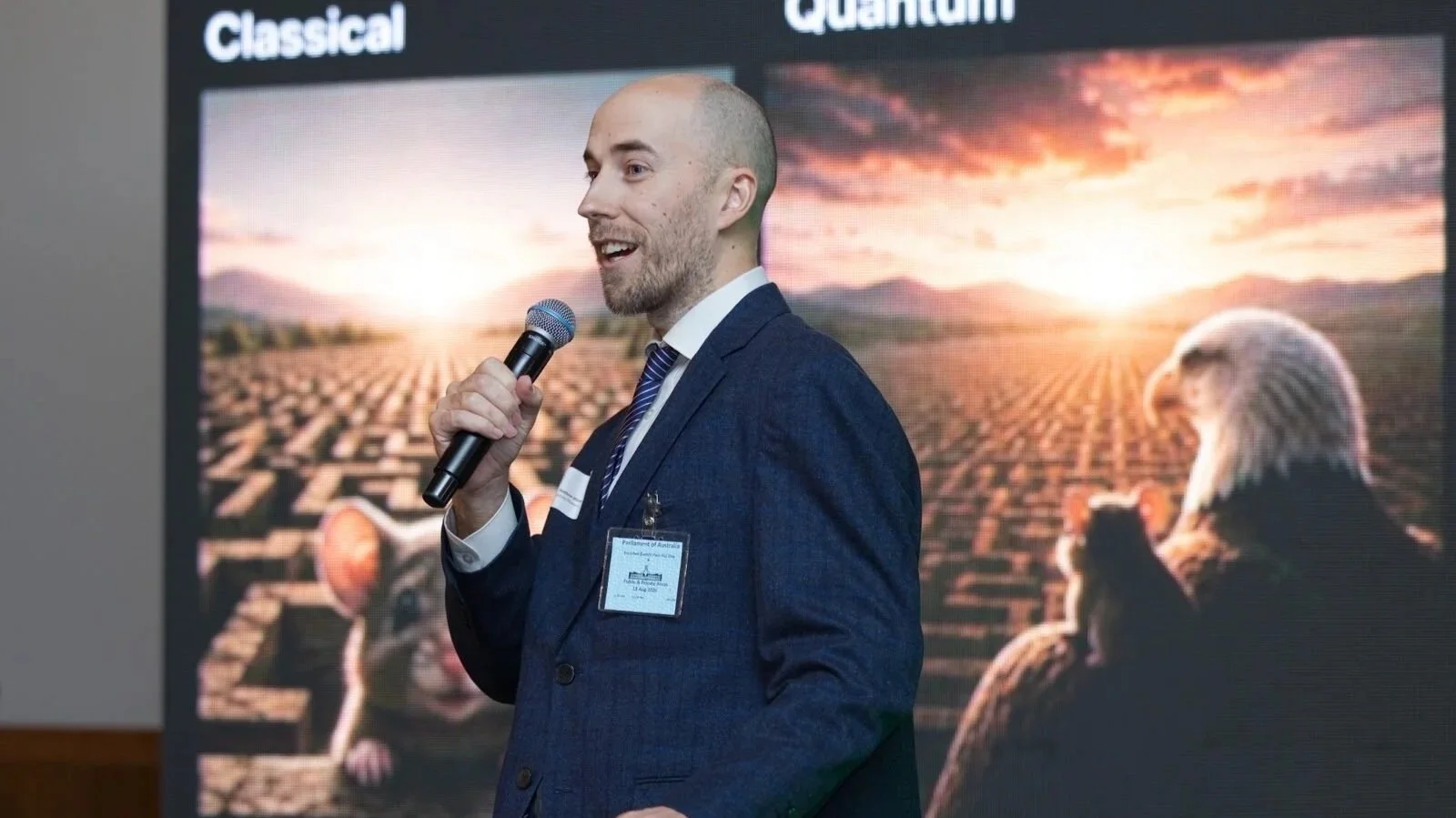
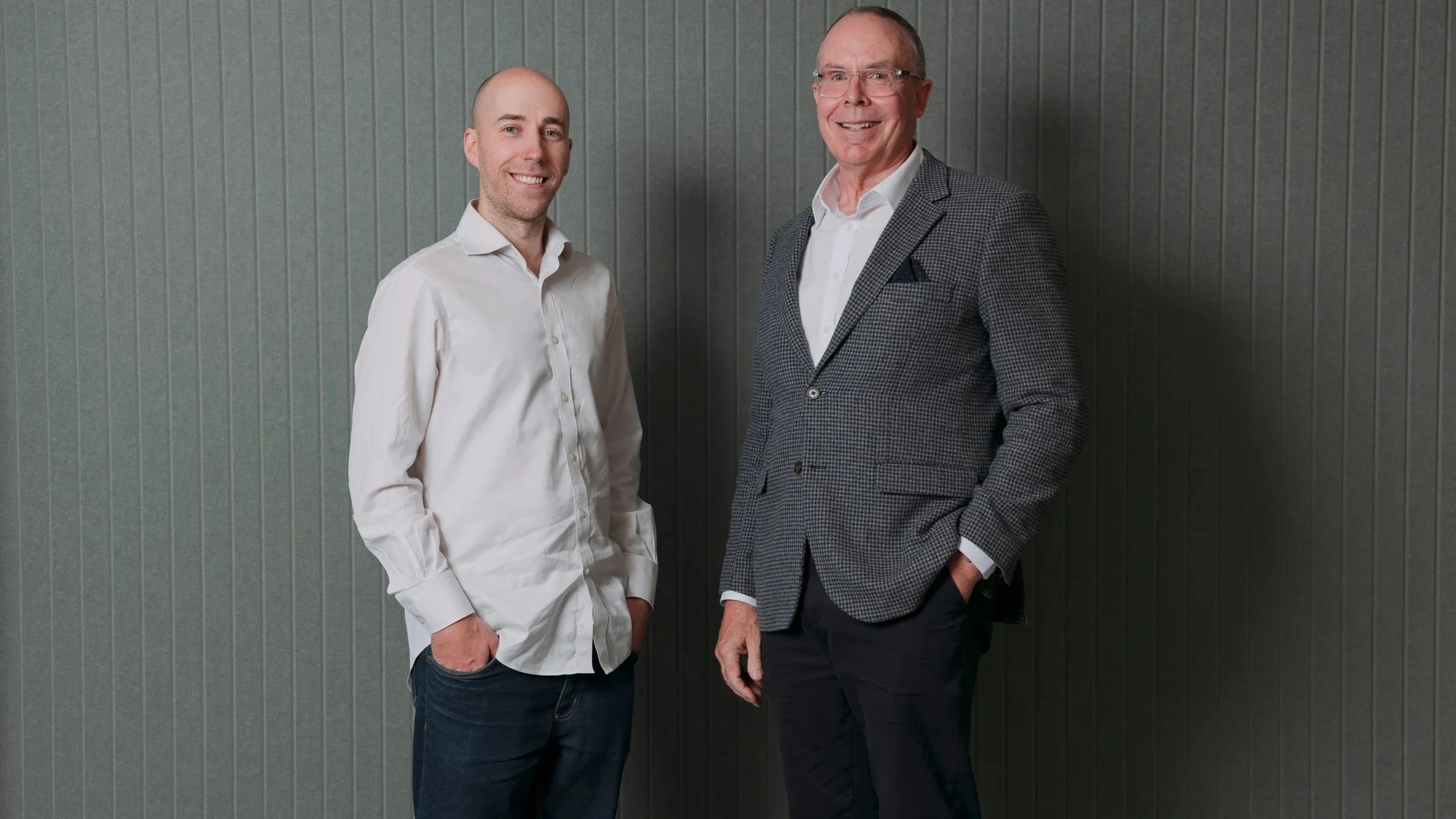
Dr. Matthew Winnel, Co-founder and Chief Technology Officer of GridState Photonics.
Quantum computing’s noise problem
Every quantum computer must solve the same problem before it can do anything useful: it must correct its own errors faster than they accumulate. The mainstream route to that goal is redundancy — spreading the information of one dependable “logical” qubit across many noisy physical ones, so that no single failure sinks the calculation. The catch is the sheer count.
Useful machines are widely expected to need on the order of a million physical qubits, and by Baines’s reckoning the leading players are already pouring hundreds of millions of dollars a year into wrangling the error-correction problem.
GridState Photonics does not claim to do away with that redundancy, and its own machine would still need a great many optical qubits. Its argument is narrower and, the founders would say, more useful: that photonics can lower the overhead — the number of physical resources each reliable logical qubit consumes — provided you can solve the problem that has held the approach back.
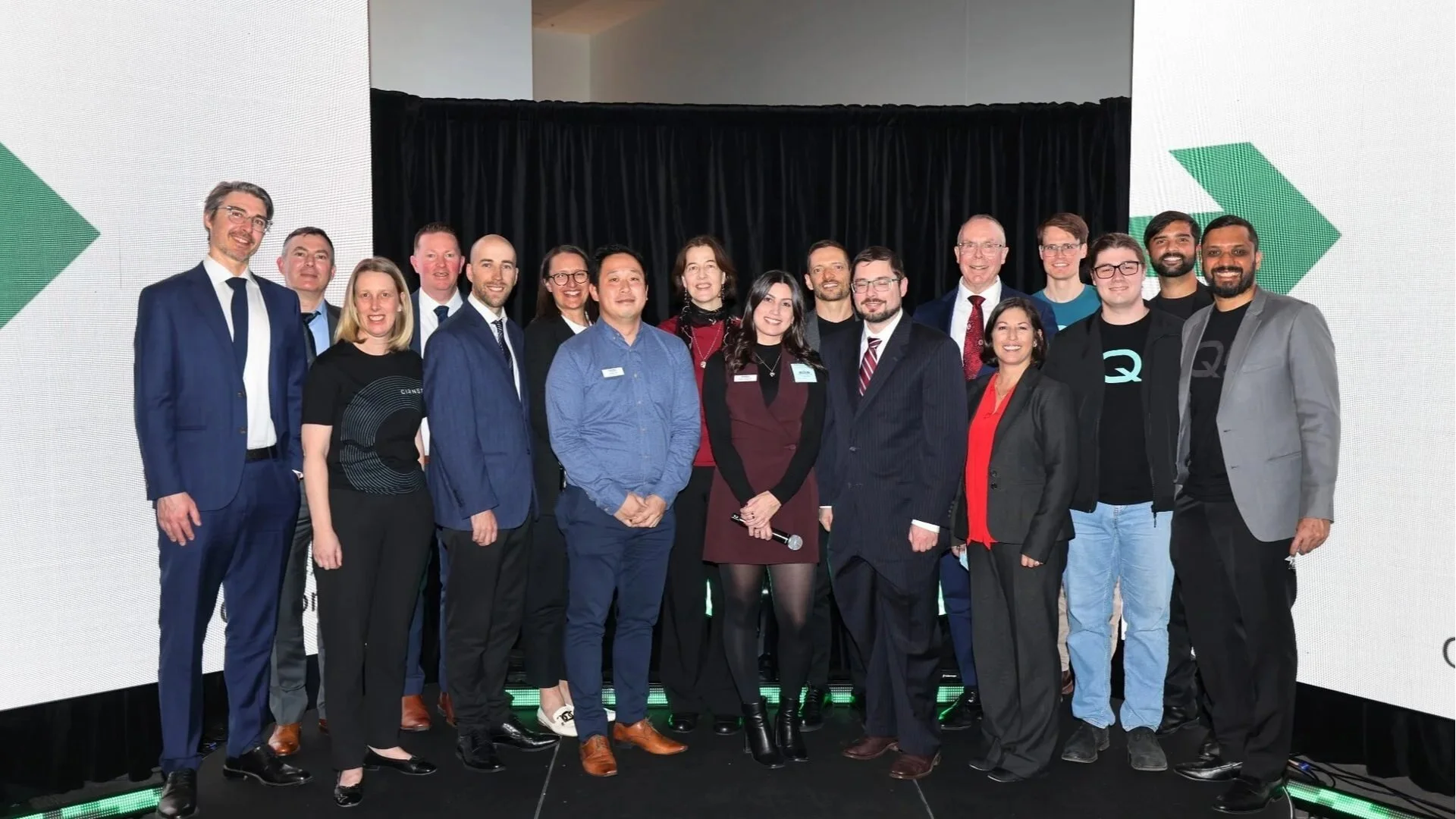
NextQ Cohort, Quantum Australia Showcase, Parliament House
A grid of light
That problem is manufacturing the exotic quantum states of light on which the scheme depends. GridState Photonics’ approach — continuous-variable quantum computing — still encodes a logical qubit with logical zero and one states; what changes is the physical representation. Those logical states are carried in the continuous variables of light: the amplitude and phase of a light field, mapped onto a lattice of points in what physicists call phase space. They are known as GKP states, after the physicists who proposed them.
The appeal is that error correction is built into the encoding. If noise displaces the state from the grid, the machine can measure an error syndrome and apply a corrective displacement — or fold that correction into measurement and feed-forward — to return it to the nearest lattice point. The correction is comparatively simple, but it is active rather than automatic: it is done with optical elements such as beam splitters, phase shifters and detectors. Only sufficiently small displacements can be unambiguously corrected, larger shifts can produce logical errors, and real GKP states are finite-energy approximations rather than perfect grids.
The hard part is making those grid states of light in the first place. Many existing optical methods are probabilistic, with success rates that can fall sharply as the target state becomes larger and higher in quality. The theoretical proposal underlying GridState Photonics offers a deterministic route from photon-number states to large squeezed cat states, which can then be combined to produce approximate GKP states — the grid states that give the company its name.
Get that right, the founders argue, and one of the hardest pieces of the machine is in place. It would not be the last: a fault-tolerant optical computer still needs very low-loss components, large entangled cluster states, squeezing, precise mode matching, efficient photon-number-resolving detection, high-speed feed-forward, control electronics and scalable fabrication. But those are built from the well-understood optical workhorses of beam splitters, phase shifters and light detectors.
The company frames its contribution as error suppression at the optical layer: improving the encoded states and correcting small displacement errors as they arise, before a higher-level error-correcting code is left to handle the remaining failures.
Two people, a big bet
For all the ambition, GridState Photonics is at the very beginning: the invention has not yet been demonstrated in the lab, and the immediate task is to prove it works. The founders are not starting from scratch, though — the theory rests on very well characterised optics.
The founders’ roadmap is to produce the precursor cat states within roughly nine months, and the full grid states within two to three years.
To get there, the company has joined NextQ, Quantum Australia’s 20-week accelerator for early-stage quantum ventures, and is raising a seed round of A$3 million. The prize the founders point to is first-mover advantage in optical error correction, a market they estimate at A$7–10 billion.
If the technology works, its uses reach beyond computing. Winnel notes that the same ability to correct for lost light could strengthen quantum key distribution, the basis of provably secure communication, by enabling the quantum repeaters that long-distance quantum networks will need, with further potential in precision measurement and quantum simulation.
Baines sums up the mission plainly: GridState Photonics, he says, is in the business of making optical photonic quantum computers actually work. Whether the light can be tamed as neatly in the lab as it is on paper is the question the next two years will answer.
Related articles