Taking Quantum Gravimetry Underground to reduce Uncertainty in Cave Mine Modelling
Mines are not short of data, yet conventional underground monitoring leaves tens of metres of uncertainty in the location, shape and geotechnical behaviour of cave features, directly impacting ore recovery and safety. Nomad Atomics’ quantum absolute gravimeter, |g|, overcomes existing gravimetry limitations. Portable, handheld and drift-free, it enables efficient, precise and repeatable underground surveying so changes can be tracked over time. Operating from the extraction level, non-invasive surveying enables accurate density modelling that reduces uncertainty in one of the highest stakes mining methods so operators can make more informed decisions.
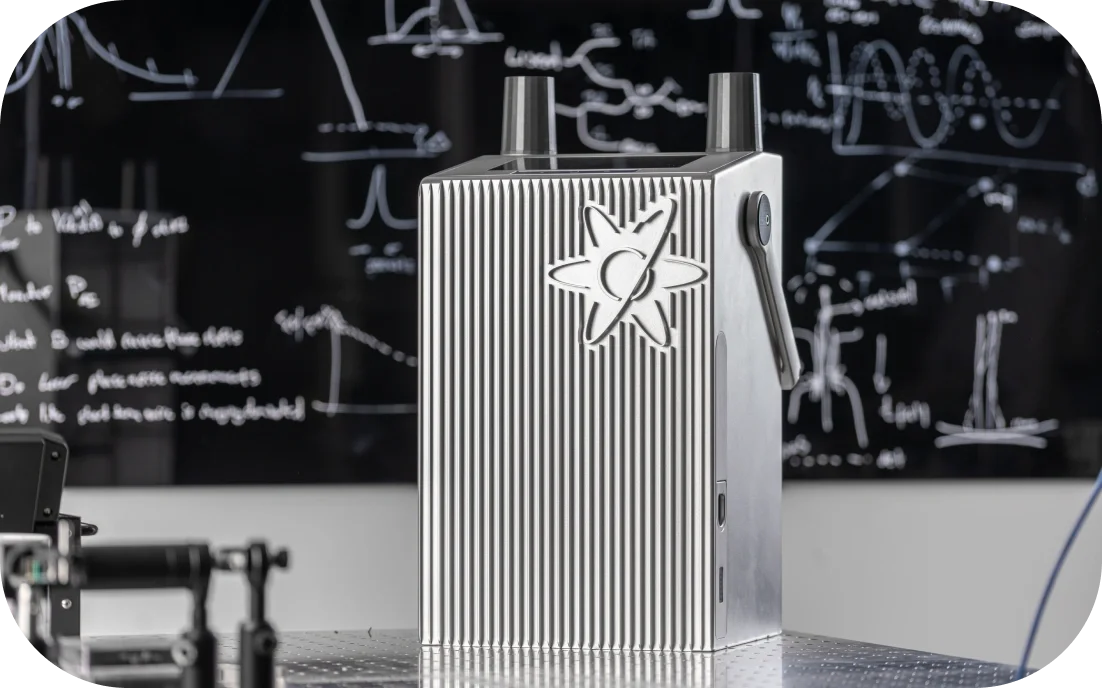
Image credit: Nomad Atomics
Company: Nomad Atomics (Melbourne, VIC)
Quantum technology: Quantum gravity sensing (atom interferometry / gravimetry)
Industry validation: Underground field trial plus multiple feasibility studies using realworld density models of working block-cave mines (including work presented at MassMin 2024)
Application: Time-lapse 3D imaging of block and sub-level cave mines from the extraction level – cave-back position, air gap, muck pile distribution and mass balance
Impact: Reduced geotechnical uncertainty, earlier warning of air-blast and chimneying risk, improved draw control and recovery, and continuous monitoring across the life of the mine without surface access
End user / industry application: Underground cave mining operations for the noninvasive, in-mine monitoring of cave geometry and propagation.
Block and sub-level cave mines are not short of data. Seismic arrays, cave-tracking beacons, drill-hole logs, numerical models and production records are all standard parts of the monitoring toolkit. The problem is not the volume of data, it is that existing methods often cannot reliably resolve the location, shape and behaviour of cave features with enough confidence to support operational decision making.
Information on cave propagation, cave-back position, chimneying and air-gap development directly impact both safety and production planning. Poor understanding of these features drive real operational risk; events such as air blasts, triggered by cave instability, have fatal consequences and can shut a mine down for months, whereas unexpected chimneying or stalled propagation can leave valuable ore unrecoverable. Across much of the industry, these decisions are being made on incomplete information.
Each monitoring method has its limits. Seismic surveys can carry 40–50 metres of uncertainty in locating cave features, with signals degraded by certain rock types and conditions. Cave trackers and beacons require permanent installation and capital commitment, and can be lost, damaged or lose connection. Conventional relative gravimeters drift over time and must be tied to absolute reference points, meaning surveys taken months apart cannot be reliably compared, ruling them out for deep underground monitoring.
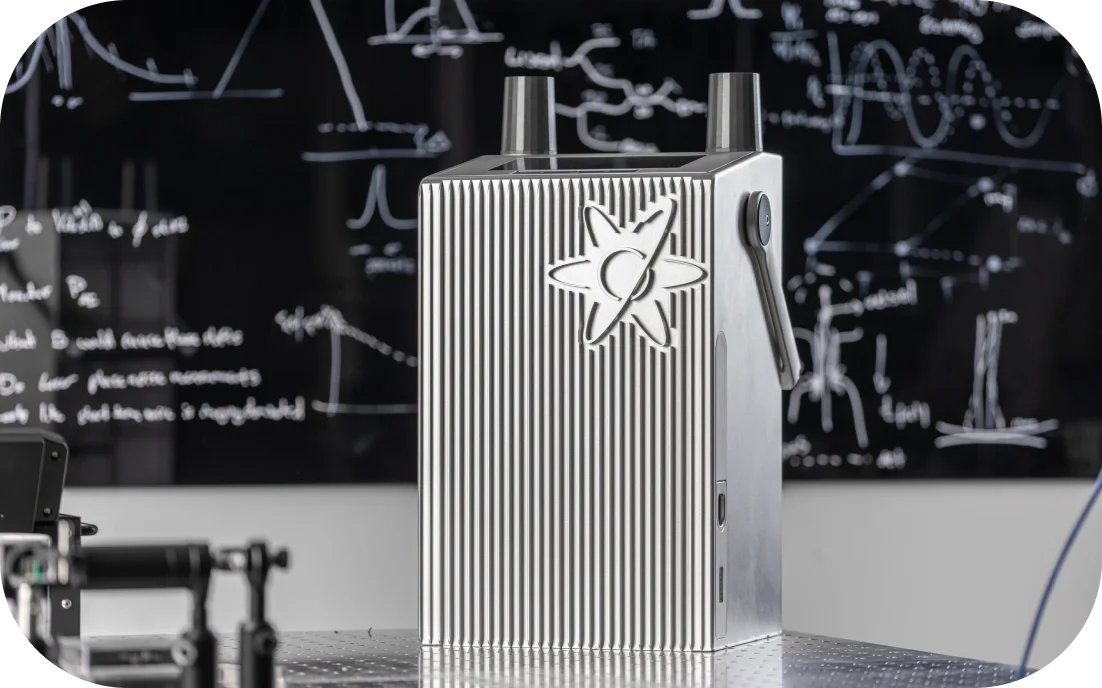
Nomad Atomics has developed the world’s smallest field-ready quantum absolute gravimeter, |g|. It measures gravity using laser-cooled atoms in free fall, a technique that eliminates mechanical drift entirely and is minimally sensitive to environmental conditions. This produces stable, absolute measurements that can be directly compared across surveys taken months or years apart, something conventional gravimeters cannot do. Where earlier quantum gravimeters were confined to laboratories or vehicle-based deployments, |g| is portable and handheld, built for active mining environments.
Nomad Atomics delivers a full-stack capability covering sensor design and manufacturing, field operations and proprietary analytics. For underground cave mining, this means gravity data is converted into time-lapse 4D density models of the mine. Surveys are run from extraction drives by a two-person crew, with no permanent hardware or ongoing maintenance required. The result is a direct, evolving picture of cave-back position, air-gap development and mass distribution, significantly reducing positional uncertainty.
The approach is passive, repeatable and nondestructive, and complements existing monitoring datasets rather than replacing them. It also continues to function across the full life of the mine, including after surface access is lost. Nomad Atomics has demonstrated the technology through underground field trials and feasibility studies in active cave mines and is actively seeking further deployment opportunities.
The same quantum sensing capability extends beyond mining to fields where tracking subsurface density changes with precision and repeatability has long been a limitation. Other use cases include detection of subsurface water leaks in urban utilities, efficient and precise mineral exploration, groundwater modelling and CO₂ storage monitoring.
“We built |g| to bring quantum precision into environments where it can impact real operational decisions. Underground mining is exactly that kind of environment, and we are excited to see what becomes possible when operators have this level of visibility underground.”
Related Use Cases